
How to Choose a Web Design Agency: 12 Questions to Ask Before You Hire
November 18, 2026 · By Lumaaro
Choose a web design agency by checking that its past work matches your needs, its process is clear, you will own the finished website, it builds for speed and SEO, and it offers support after launch. Ask for proof, written scope and a named contact, and avoid anyone guaranteeing rankings.
What should you look for in a web design agency?
Look for evidence that the agency can solve your kind of problem and will still be there after launch. Pretty screenshots are not enough; you need to understand how they work and what happens when something goes wrong.
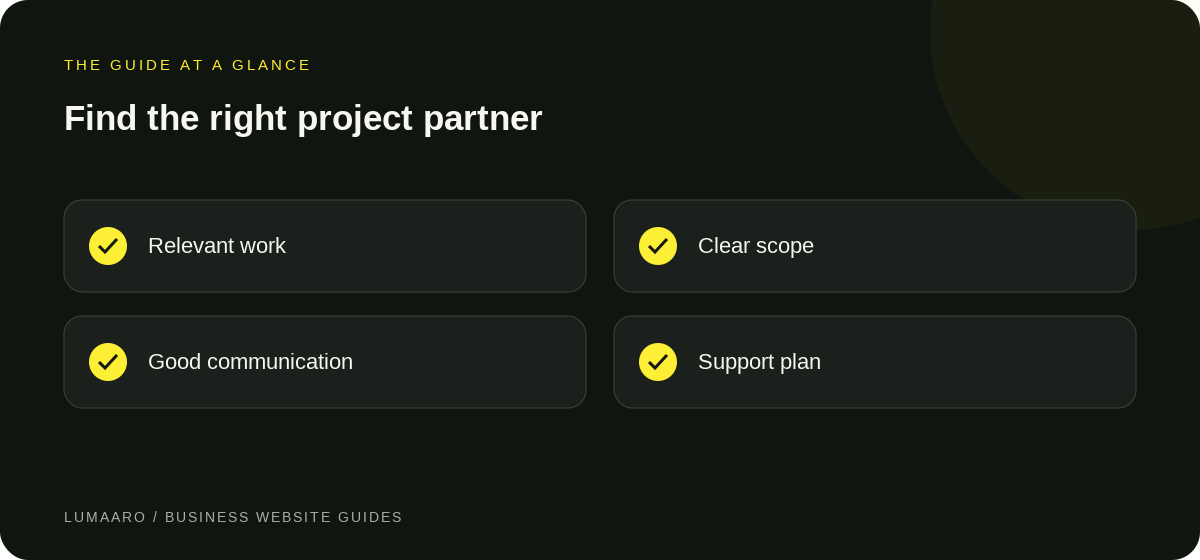
The core qualities are relevant experience, a transparent process, clear communication, technical quality and long-term support. A team that covers design, development and maintenance reduces hand-offs and finger-pointing.
What are the 12 questions to ask?
- Have you worked on websites like mine? Ask for examples in your industry or with similar goals, and what results followed.
- Who will work on my project? Confirm the designer, developer and project lead, and how they communicate with you.
- What is your process? A good agency can describe discovery, design, build, testing and launch in plain steps.
- What exactly is included? Get pages, revisions, content help, integrations and testing in writing.
- Which platform will you use, and why? The answer should come from your needs, not habit. See our platform comparison.
- Will I own the website? Confirm ownership of the domain, hosting access, design files and content.
- How do you build for speed and SEO? Ask about performance targets, structured data, redirects and mobile design.
- How do you handle accessibility? Look for keyboard use, contrast, labels and testing.
- How long will it take, and what do you need from me? Realistic timelines depend on timely content and approvals.
- How do revisions and changes work? Know the limit and the cost of extra work.
- What happens after launch? Ask about training, support, updates, backups and security. Our maintenance plans are one example.
- How will we measure success? Agree on enquiries, sales or other outcomes, not only visual approval.
What are the red flags?
Be cautious when you see any of these:
- A guaranteed first-page ranking or fixed traffic numbers.
- A price far below every other quote with no clear scope.
- No named team members, reviews or examples.
- Reluctance to give you account access or file ownership.
- No discussion of your goals, audience or content.
- Heavy pressure to sign quickly.
- Templates presented as custom design without saying so.
Should you hire a freelancer, an agency or build in-house?
It depends on scope and continuity. A freelancer can be a good fit for a small, well-defined project. An agency brings a team across design, development, testing and support, and continuity when one person is unavailable. In-house suits organisations with continuous product work and the budget to hire.
| Option | Strength | Watch for |
|---|---|---|
| Freelancer | Direct contact, flexible cost | Single point of failure, limited skills range |
| Agency | Combined skills and process | Quality varies; check who does the work |
| In-house | Deep product knowledge | Hiring and management cost |
How do you compare proposals fairly?
Compare scope, not price. Put each proposal side by side against the same brief, and check what is excluded. Our planning guide and the cost guide show how to do this, and the free project planner helps you write a clear brief first.
Frequently asked questions
How long does a web design project take?
Small business websites commonly take several weeks, while larger sites and stores take longer. Timelines depend mostly on how quickly content and approvals arrive.
Should I ask for a prototype before I hire?
A paid discovery or design phase is a reasonable way to test collaboration on larger projects. Free speculative work is less common and often shallow.
Is it better to use one agency for design and development?
Usually, yes. A single team avoids translation gaps between design and code, and one party is accountable for the result.
What does Lumaaro do differently?
We combine UI/UX design, web development and ongoing maintenance in one team, so a project moves from idea to launch and long-term care without hand-offs.
Talk to a team that covers it all
Contact Lumaaro and ask us any of the questions above. We are happy to answer them in writing.