

SEO, AEO and GEO: How to Get Your Business Found in Google and AI Answers
November 18, 2026 · By Lumaaro
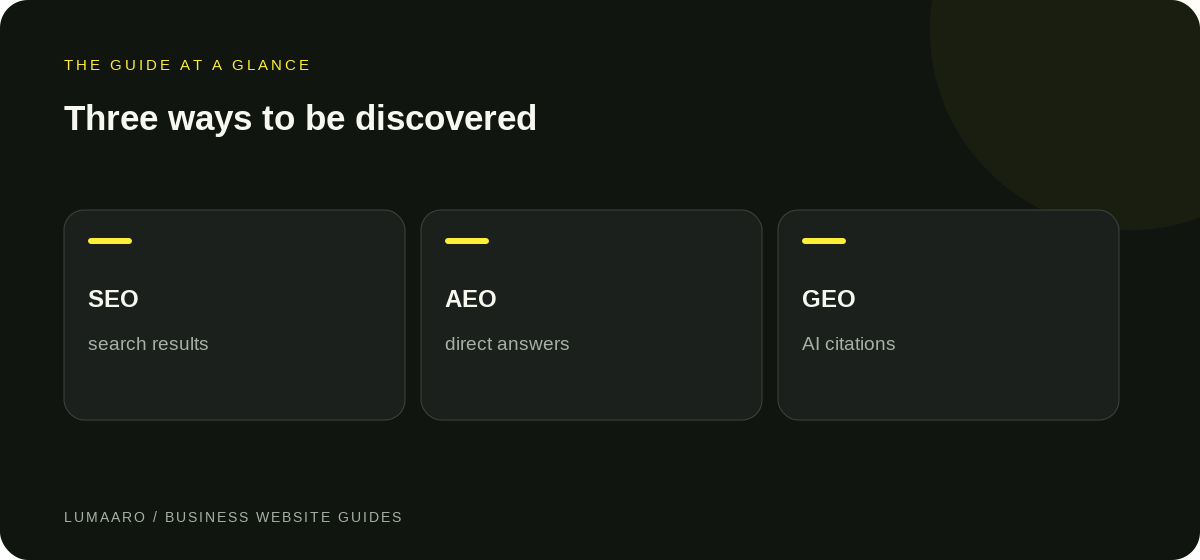
SEO helps your pages rank in search results, answer engine optimisation (AEO) helps AI assistants and search features quote your answers, and generative engine optimisation (GEO) helps your brand appear in AI-generated summaries. All three depend on the same foundation: a fast, crawlable website with clear, original, well-structured content.
What is the difference between SEO, AEO and GEO?
They overlap, but each targets a different way people find information. Traditional SEO focuses on ranking pages for keywords. AEO and GEO focus on being understood and cited when a person asks a question and an AI system writes the answer.
| Approach | Goal | What it rewards |
|---|---|---|
| SEO | Rank pages in search results | Relevance, helpful content, technical health, links |
| AEO | Be the quoted answer to a question | Direct answers, headings that match questions, structured data |
| GEO | Be cited in AI-generated summaries | Clear entities, original data, coverage of the topic, trust signals |
No one can guarantee a ranking or an AI citation. You can make your site easy to crawl, easy to understand and worth citing.
How do you make a business website easy for search engines to crawl?
Start with technical health, because content cannot rank if it cannot be reached or rendered.
- Serve every page over HTTPS with a valid certificate.
- Publish an XML sitemap and a valid robots.txt that does not block important pages.
- Give each page a unique title, a meta description and a single H1.
- Keep pages fast: aim for Core Web Vitals in the good range.
- Make the site work on mobile devices, since search indexing is mobile-first.
- Use a logical internal link structure, so key pages are easy to reach.
Our speed guide covers the performance side in detail.
How do you write content that ranks and gets cited?
Answer the question first, then add depth. Write for the decision-maker who is comparing options, and cover the topic fully so there is no need to open another site.
- Put a clear 40 to 60 word answer directly under the heading that asks the question.
- Use question-style H2 and H3 headings that mirror how people actually ask.
- Add proof: original examples, process details, numbers you can stand behind and screenshots.
- Use lists, tables and short paragraphs so passages can be understood on their own.
- Keep one page per distinct service, with its own URL and purpose.
- Update pages when facts change and show the date.
Avoid thin, repetitive pages created only to match keywords; they add little for readers or search systems.
What is bottom-of-funnel content?
Bottom-of-funnel content serves people who are ready to hire. It includes service pages, pricing guidance, comparison pages, case studies and answers to purchase questions. These searches have lower volume but strong buying intent, so one visit can be worth many casual ones.
For a web agency, that means pages such as web development services, UI/UX design services and website maintenance plans, supported by guides such as how to choose a web design agency.
How do AI assistants decide what to cite?
AI answer systems retrieve passages from pages and combine them. Pages that make passages easy to extract and verify are easier to cite. That usually means a direct answer near the top, a clear heading, supporting detail and consistent facts about who you are.
To make that easier:
- Allow search and AI crawlers in robots.txt where you are happy to be cited, such as GPTBot, OAI-SearchBot, PerplexityBot and ClaudeBot.
- Add structured data (Organization, Service, Article, FAQPage, BreadcrumbList) that matches the visible text.
- Describe your business, services and contact details identically across your site and profiles.
- Publish original information that other sites reference, such as your process, checklists and tools.
- Consider an llms.txt file as an emerging, optional summary for language models.
How should you measure results?
Measure outcomes, not only rankings. Track organic impressions, clicks and enquiries in Google Search Console and analytics, and watch which queries and pages bring qualified leads.
For AI visibility, test the questions your customers ask in several assistants on a regular schedule, record whether and how your business is mentioned, and note which pages are cited. Results change as the systems change, so treat this as ongoing monitoring.
Frequently asked questions
Is SEO still worth it with AI search?
Yes. AI features draw on indexed, trustworthy pages, so the same foundations of helpful content, technical health and authority help in both. SEO is the base that AEO and GEO build on.
Do I need an llms.txt file?
It is optional and not a ranking factor. It is a low-effort summary that can help language-model tools understand your site, but it does not replace good content and structure.
How long does SEO take to work?
Often several months for competitive terms, faster for specific, low-competition queries. Results depend on competition, content quality and site authority.
Can Lumaaro help with SEO?
We build websites with technical SEO and structured data in place, and our maintenance plans include SEO and analytics checks. We do not promise rankings.
Make your website easy to find
Ask Lumaaro about building or improving a website that is ready for search engines and AI answers.