

How Much Does a Business Website Cost? What Drives the Price
November 18, 2026 · By Lumaaro
A business website costs whatever its scope requires: the number of unique page layouts, the amount of custom design, the platform, the integrations and the content work all change the price. Two five-page sites can differ greatly. Compare proposals by deliverables and exclusions, not by headline price alone.
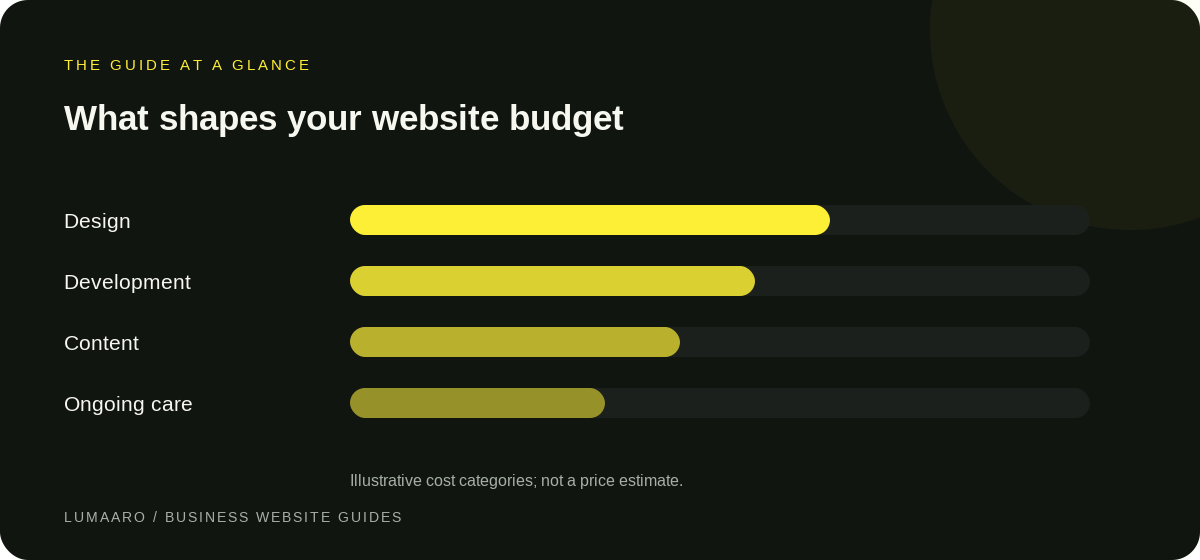
What actually determines the cost of a business website?
Cost follows effort and risk. A brochure website using a clean, well-built template layout needs less design and testing time than a site with custom booking rules, member areas or a large product catalogue. Quotes differ because agencies make different assumptions about what is included.
The factors that move the price most are:
- Design depth: reusing an established layout, adapting a design system, or designing every page from research.
- Functionality: forms, bookings, payments, accounts, search, multilingual content and calculators.
- Content: who researches, writes, edits and photographs, and how many pages are needed.
- Integrations: CRM, email marketing, accounting, inventory and payment providers.
- Migration: moving existing pages, products and customer data while protecting search traffic.
- Care after launch: updates, backups, security monitoring and content changes.
Why do two quotes for the same website look so different?
Quotes are usually written against different assumptions. One proposal may include discovery, copywriting, three design revisions, accessibility testing and a month of post-launch support. Another may include a template, installation and a handover. Both can be described as "a five-page website".
Ask each agency to separate these lines so you can compare like for like:
| Line item | Question to ask |
|---|---|
| Discovery | Is research and planning included, and what do I receive from it? |
| Design | How many unique layouts and revision rounds are included? |
| Development | Which platform, and is the code built for speed and accessibility? |
| Content | Who writes, edits and supplies images, and are changes charged? |
| Launch | Are redirects, analytics, forms and testing included? |
| Care | What is covered after launch, and what is the response time? |
Is a cheap website a good deal?
It can be, when the need is simple and you are happy to do the content and care yourself. It becomes expensive when the site loads slowly, breaks on phones, cannot be edited by your team or cannot grow with your business. Fixing structural problems later usually costs more than building them correctly first.
A useful test: if the price is far below every other quote, find out which of the items in the table above is missing. The difference is often design thinking, testing or support.
How does the platform affect cost?
The platform changes both the build cost and the running cost. WordPress offers flexibility and ownership but needs ongoing updates and security care. Shopify handles hosting and checkout for stores but charges monthly fees and app subscriptions. A custom build gives full control but needs more engineering and long-term support. Our guide to WordPress, Shopify and custom builds compares them in detail.
What are the ongoing costs after launch?
Launch is the start of the running costs. Plan for the domain, hosting, any paid plugins or apps, email, and a maintenance plan. Many owners also budget for regular content updates and small improvements driven by analytics.
A monthly website maintenance plan keeps updates, backups, uptime and security checks with a team that already understands your site. Without one, someone in your business needs to own those tasks.
How can you get an accurate quote?
Prepare a brief before you ask. The clearer the brief, the closer the first quote will be to the final price. Include your goal, audience, current website address, the pages you need, essential features, the state of your content and your preferred launch window.
Our free website project planner turns those answers into a brief you can send to any agency. For the full process, read the business website planning guide.
Frequently asked questions
Should I pay a fixed price or hourly for a website?
A fixed price suits a clearly defined scope, because both sides know the deliverables. Hourly or retainer work suits evolving projects and ongoing improvement. Whichever you choose, write the scope, revision limits and change process into the agreement.
Are website cost estimates found online reliable?
Treat them as rough guides only. Costs depend on your market, scope and the team you hire, and online averages mix very different kinds of projects. A written proposal against your own brief is the only reliable figure.
What hidden costs should I watch for?
Watch for paid plugins or themes that renew every year, stock photography, premium integrations, extra revision rounds, content writing, data migration and charges for post-launch fixes. Ask which items recur and who pays for them.
Can I start small and expand the website later?
Yes. Launching a focused first version with clean foundations is often smarter than building everything at once. Choose a platform and structure that can grow, and keep a list of phase-two features with the reasons for each.
Get a clear proposal for your project
Talk to Lumaaro about your website. We will explain what is included at each step, so you can compare us with any other agency on the facts.