

WordPress vs Shopify vs Custom Website: Which Platform Should You Choose?
November 18, 2026 · By Lumaaro
Choose WordPress for content-led business websites that need flexibility and ownership, Shopify for stores that want to sell quickly with hosted checkout, WooCommerce for stores that need deep customisation, and a custom build when your product or workflow does not fit a standard platform. The right answer follows your business model, not trends.
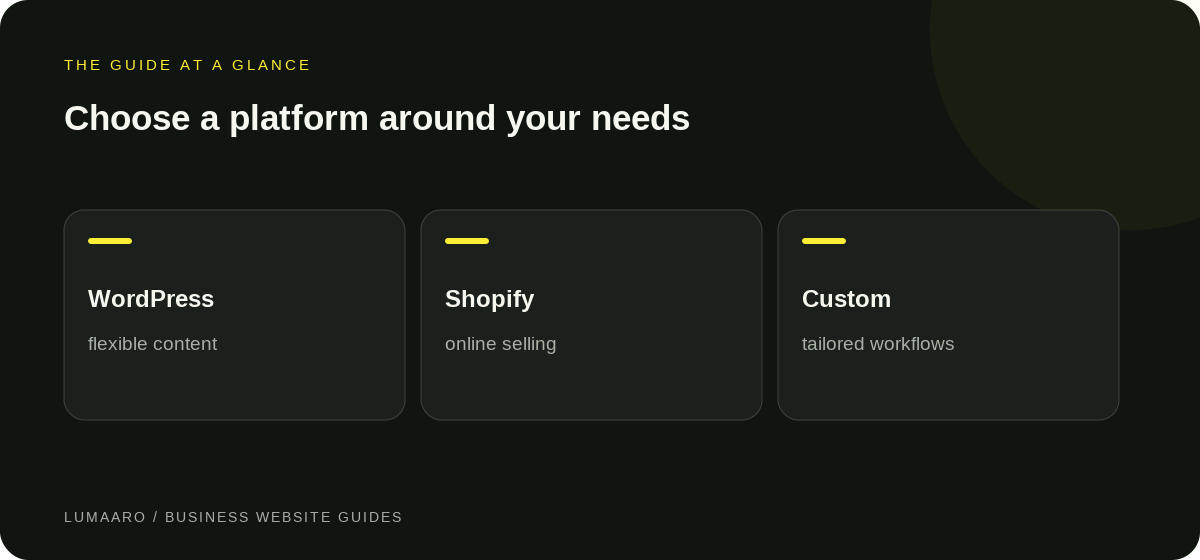
How do you choose the right website platform?
Start with what the website must do every week, then pick the platform that makes those tasks easy. A consultant who publishes articles and takes enquiries has different needs from a retailer managing hundreds of products.
Answer these questions first:
- Will visitors mainly read, enquire, book or buy?
- Who will update the site, and how technical are they?
- How many products, pages or user roles will you have in a year?
- Which systems must connect: payments, CRM, inventory, accounting?
- Do you need to own and move the website, or is a hosted service acceptable?
What are the strengths of WordPress?
WordPress is a flexible content management system used for everything from small business sites to large publications. You own the website and can host it where you like. It is strong for content marketing, service businesses and any site where editing and SEO control matter.
Its trade-off is responsibility. Core, theme and plugin updates, backups, security and performance all need regular attention, which is why a website care plan matters. A well-built WordPress site with limited, trusted plugins can be fast, secure and easy to edit.
When is Shopify the better choice?
Shopify is a hosted store platform. It provides checkout, payments, hosting and security as part of the service, so you can launch a store quickly and spend less time on technical upkeep. It suits businesses whose main goal is selling products online with a standard store experience.
The trade-offs are monthly fees, app subscriptions and less freedom over unusual workflows or content-heavy sites. Customisation is possible, but some changes depend on the platform's rules and available apps.
What about WooCommerce?
WooCommerce adds store features to WordPress. It gives you ownership and broad flexibility: custom product types, complex shipping and tax rules, memberships and integrations. It suits stores that need more control or tight links between content and commerce.
It needs more hands-on care than a hosted platform, including hosting capacity, updates, payment testing and security. Our e-commerce store development covers WooCommerce and Shopify builds.
When should you build a custom website?
Build custom when your product is a web application, when you need specific user roles, data models or workflows, or when the performance and security requirements are unusual. Custom code gives complete control and a tailored experience.
It also brings the highest build cost and a long-term responsibility to maintain, document and extend the system. For most brochure sites and standard stores, a proven platform delivers the result faster and with less risk.
How do the platforms compare?
| Factor | WordPress | WooCommerce | Shopify | Custom build |
|---|---|---|---|---|
| Best for | Content and service sites | Flexible stores | Fast-launch stores | Web apps and unique workflows |
| Ownership | Full | Full | Hosted service | Full |
| Editing | Easy with good setup | Easy with good setup | Easy | Depends on the admin built |
| Upkeep | Updates and security needed | Updates and security needed | Mostly handled by platform | Developer-dependent |
| Flexibility | High | High | Moderate | Highest |
| Running costs | Hosting, plugins, care | Hosting, plugins, care | Plan plus apps | Hosting plus engineering |
Does the platform affect SEO?
Every platform can rank well when the site is fast, crawlable and helpful. What matters is clean structure, sensible URLs, accurate titles and descriptions, mobile usability, structured data and quality content. Poor builds on any platform hurt rankings; good builds on any platform can compete.
Read how to speed up your website for the performance side, and our web development service for how we build SEO-ready sites.
Frequently asked questions
Can I move from one platform to another later?
Yes, but plan it as a migration project. Content, products, redirects and customer data must be mapped and tested so that search traffic and orders are protected. Choosing a platform with good export options reduces future pain.
Is WordPress still a good choice?
Yes, for businesses that want flexibility, ownership and strong content tools. Success depends on a careful build, restrained plugin use and regular maintenance.
Which platform is cheapest?
It depends on the whole cost, not the starting price. Compare build, hosting, plugins or apps, transaction fees and care across a year or two. The cheapest starting point is not always the lowest total cost.
Can Lumaaro build and maintain on any of these platforms?
We design, build and maintain websites on WordPress, WooCommerce, Shopify and custom code, and recommend the one that fits your goals.
Not sure which platform fits?
Tell us about your project and we will recommend a platform and explain the reasons in plain language.