

Worked Example: An Online Store for a Handmade Skincare Brand
November 18, 2026 · By Lumaaro
Example project. This worked example is an illustrative scenario that shows how Lumaaro approaches e-commerce projects. It is not a past client engagement and contains no real client results.
For a small skincare brand, we would build a fast WooCommerce or Shopify store around clear product pages, simple checkout and strong trust signals, then protect it with monthly maintenance. Success would be measured by completed orders, checkout drop-off and page speed, not by traffic alone.
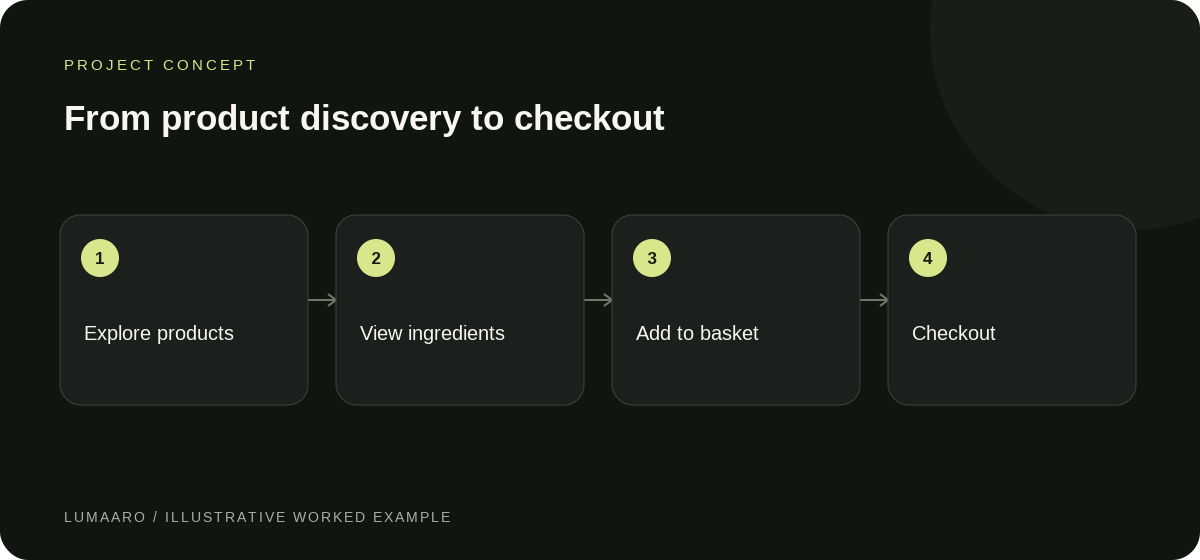
What is the scenario?
A small brand makes skincare products by hand and sells through social media and marketplaces. Orders arrive by direct message, margins are squeezed by marketplace fees, and there is no website the team can manage themselves.
What are the main challenges?
- Product pages must explain ingredients, usage and delivery clearly, because buyers cannot touch the product.
- Most visitors arrive on phones from social media, so mobile speed and checkout are critical.
- The team has no developer, so day-to-day editing must be simple.
- Payment, tax and delivery rules must work for the markets they sell to.
How would we approach the UX and UI design?
- Research the questions buyers ask before purchase and answer them on the product page.
- Design a mobile-first catalogue with clear photography, ingredients, reviews and delivery information.
- Reduce checkout to the fewest steps and show total cost early.
How would we build the website?
- Choose Shopify for a fast launch and hosted checkout, or WooCommerce if content and custom rules matter more. See our platform comparison.
- Compress images, limit apps or plugins and test Core Web Vitals on a mid-range phone.
- Set up payments, shipping zones, tax settings and order emails, then test real purchases.
How would we handle SEO, AEO and GEO?
- Give every product and collection a unique title, description and helpful copy.
- Add Product, Breadcrumb and FAQ structured data that matches visible text.
- Publish buying guides that answer skincare questions in plain language.
How would we look after it after launch?
- Monthly updates, off-site backups, uptime and security monitoring.
- Small content and product changes handled through a care plan.
What would the client receive?
- Research notes and a prioritised page list
- Mobile and desktop designs in Figma
- A built, tested store with payments and shipping configured
- Analytics and conversion tracking
- Editing training and a maintenance plan
How would we measure success?
We would agree a baseline before launch and review these measures against it, rather than relying on traffic alone:
- Completed orders and conversion rate
- Checkout abandonment and where it happens
- Mobile Core Web Vitals (LCP, INP, CLS)
- Share of orders from search and direct visits
- Repeat purchase rate
Which tools and technology would we use?
Shopify or WooCommerce, Figma, a payment provider suited to the market, analytics and uptime monitoring.
Frequently asked questions
How long would a project like this take?
A focused store with a defined catalogue commonly takes several weeks, depending mainly on product data, photography and how quickly decisions are made.
Should a small brand choose Shopify or WooCommerce?
Shopify suits teams that want to launch quickly with hosted checkout. WooCommerce suits brands needing more control or tight links between content and commerce.
Can the team manage products without a developer?
Yes. We set up the admin so the team can add products, change prices and update content, and we provide training.
Have a similar project?
Our UI/UX design, web development and website maintenance services cover every step shown here. Tell us about your project, or build a brief first with the free project planner.